
Beyond Attention: Understanding ADHD Through the Lens of Dysregulation

Have you ever sat across from your child diagnosed with ADHD and wondered “Why are their emotions, focus, and energy so unpredictable? ” Many parents and teachers focus on ADHD symptoms such as inattention, impulsivity, or hyperactivity. But these are just the surface.
ADHD is not simply a disorder of attention, but a broader issue of ADHD dysregulation the brain and body’s difficulty maintaining balance across emotional, cognitive, and physiological systems.
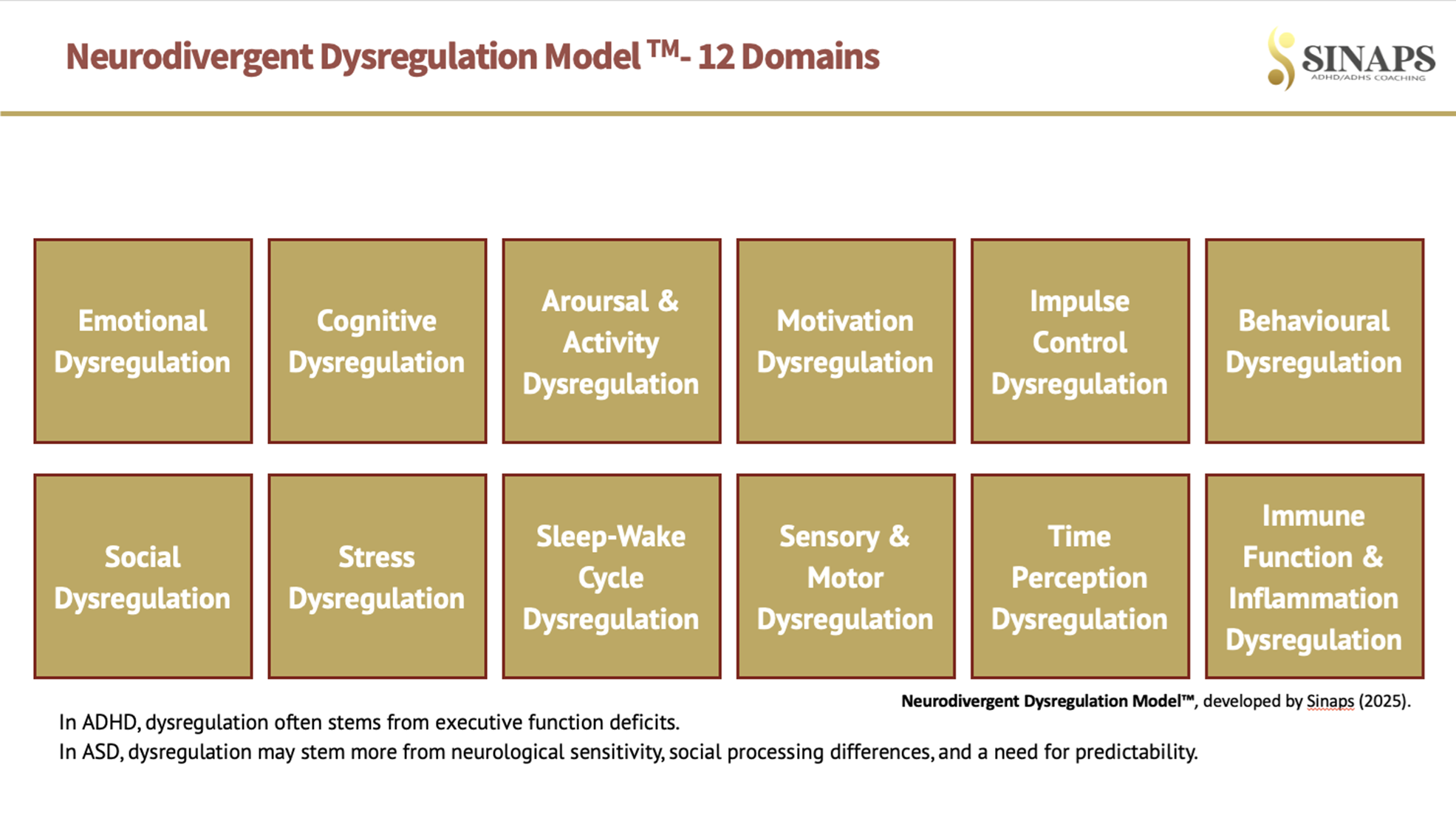
At Sinaps, we see ADHD as a disorder of self-regulation, not just self-control. That’s why we developed the Neurodivergent Dysregulation Model, a framework that explores twelve key domains where regulation can break down. Understanding these areas helps parents, teachers, and clinicians address the root causes behind a child’s or adult’s struggles rather than just managing outward behaviour.
What Is Dysregulation in ADHD?
Dysregulation means difficulty maintaining stability, flexibility, or control in response to internal or external demands.
In ADHD, this often stems from executive function deficits, the brain’s ability to plan, shift, inhibit, and self-monitor. (Barkley, 2022)
Research confirms that emotional dysregulation is a core feature of ADHD and often predicts greater impairment than the standard ADHD symptoms of inattention or hyperactivity. (Shaw et al., 2014)
When we look at ADHD through this lens, we begin to understand why it affects every part of daily life, not just school performance, but motivation, relationships, and even sleep.
The 12 Domains of ADHD Dysregulation
Below are the twelve areas where dysregulation can occur in individuals with ADHD. Each one reflects a cluster of underlying ADHD symptoms that may vary in intensity and expression from day to day.
Emotional Dysregulation – Intense, rapidly shifting emotions and difficulty calming down; frustration, rejection sensitivity, and over-reaction are common ADHD symptoms here.
Cognitive Dysregulation – Racing or scattered thoughts, inconsistent focus, and difficulty prioritising are the hallmarks of cognitive ADHD dysregulation.
Arousal & Activity Dysregulation – Alternating between hyperactivity and exhaustion; difficulty finding a balance in energy level or sustaining alertness.
Motivation Dysregulation – Struggling to start or maintain effort unless something feels urgent or interesting; classic ADHD symptom of “I can’t start until the deadline is on top of me.”
Impulse Control Dysregulation – Acting before thinking, interrupting, blurting out, or making quick decisions are core behavioural ADHD symptoms.
Behavioural Dysregulation – Difficulty maintaining routines, following through on plans, or adapting to changing expectations, even when you really want to do so.
Social Dysregulation – Challenges with social timing, reading cues, or managing social overwhelm is often a very misunderstood symptom of ADHD.
Stress Dysregulation – Overreacting to small stressors, staying “on alert,” or shutting down under pressure; the stress response system is highly sensitive in ADHD.
Sleep-Wake Cycle Dysregulation – Difficulty falling asleep, waking up in the night, and morning exhaustion is so common in ADHD and one of the most overlooked contributors to ADHD dysregulation.
Sensory & Motor Dysregulation – Sensory sensitivities, fidgeting, or seeking sensory input; the nervous system in ADHD is often over- or under-responsive.
Time Perception Dysregulation – “Time blindness,” poor estimation or sense of time, and difficulty planning and pacing tasks are well-known executive-function ADHD symptoms.
Immune Function & Inflammation Dysregulation – Emerging research links inflammatory processes with mood, cognition, chronic pain, autoimmune disorders and ADHD symptom severity.
Why This Model Matters
Traditional ADHD descriptions focus on behaviour, but when you see ADHD dysregulation across these twelve domains, the picture becomes clearer and more compassionate.
A child who “won’t start homework” may actually be struggling with motivation and stress dysregulation.
A teen who “overreacts” may be experiencing emotional and sensory dysregulation.
An adult who “never finishes tasks” may be battling time perception and sleep-wake dysregulation.
By identifying which domains are most affected, you can target support more effectively rather than relying on one-size-fits-all strategies.
Supporting ADHD Dysregulation
At Sinaps, we recommend a three-legged approach to help children, adults and families strengthen regulation capacity:
Medication – When clinically appropriate, it stabilises brain chemistry and reduces multi-domain ADHD dysregulation.
Behavioural coaching – Builds executive function skills, emotional awareness, and daily support structures help to support regulation.
Lifestyle foundations – Nutrition, exercise, and especially sleep are critical stabilisers for the dysregulated ADHD nervous system.
Scientific reviews confirm that interventions targeting executive function and self-regulation improve emotional control and symptom outcomes in ADHD. (Alegria-Arzaburu et al., 2020)
Your Next Step
When you start asking “Which system is dysregulated?” instead of “Why won’t they listen?”, everything changes. You stop reacting to behaviour and start responding to biology.
The Neurodivergent Dysregulation Model helps you see ADHD not as defiance or laziness, but as a multi-system regulation challenge that can be understood and supported with compassion, structure, and science.
That’s the heart of our work at Sinaps where we strive to help families restore balance, one system at a time.
If you’d like to understand how the ADHD dysregulation model might be showing up in your family, and what to do about it, we’d love to help.
Book a complementary call to explore strategies that can restore balance and connection.
Scientific References
Barkley, R. A. (2022). The Important Role of Executive Functioning and Self-Regulation in ADHD. Russell Barkley Factsheet
Shaw, P., Stringaris, A., Nigg, J., & Leibenluft, E. (2014). Emotion Dysregulation in Attention-Deficit/Hyperactivity Disorder. American Journal of Psychiatry, 171(3), 276–293. PMC9091051
Alegria-Arzaburu, G. et al. (2020). Systematic Review of Executive Function Stimulation Methods in ADHD. PMC11278469